
Technically speaking, our journey began at 7:30 A.M., out in front of RCMS, as students stowed their luggage beneath the bus and bid their parents farewell for three days. Then, we spent several song-filled hours on the road, making a quick stop in Moorefield for some lunch and a stretch.
BUT the trip officially began when the bus suddenly erupted in oohs, ahhs, and delighted squeals as students caught sight of the massive Green Bank Telescope between distant trees. 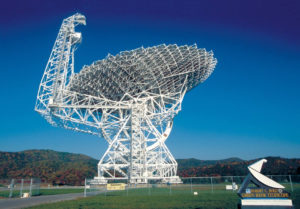 [To give you a sense of scale, the GBT dwarfs the Statue of Liberty and is almost as tall as the Washington Monument. It boasts the title of “the largest moving structure on land, and the largest fully-steerable telescope in the world.”] We wouldn’t really wrap our minds around its true engineering grandeur until day two, when we stood at the foot of the giant… but even from several miles away, and knowing very little about it or the observatory itself, the GBT was a wonder to behold.
Interruptive and Somewhat Self-Indulgent Author’s Note: By now you’ve gleaned that this longer-form journalistic post is a departure from our typical newsletter posts. It’s an attempt to approximate the experience of our entire three-day trip, all in one go. Because, interestingly, the nature of the Green Bank Observatory’s campus itself has shaped this entry’s very creation.
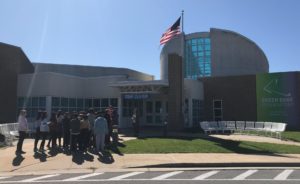
My original plan was to post a few quick highlights each evening, sharing cool things we’d learned about and providing parents with daily updates on our students’ exploits. However, because of the observatory’s severely remote location—strategically insulated against radio interference and signal noise by the surrounding mountain ranges—any contact with the outside world was limited to paid landline phone calls (cash only) and furtive ethernet emails sent from within a Faraday cage/vault/computer lab (not exaggerating—check out the microwave vault below!). I was able to collect some pictures and notes throughout the trip, but we were unyieldingly and uniquely immersed in the real-time adventure of living, learning, and working together for the duration—an experience as refreshingly disruptive for our students as it was for us adults.
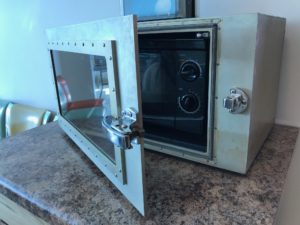
As this post is uploading, our second round of students and teachers are settling in for their second night in “the dead zone” …and I must admit I’m jealous. Tonight, ensconced in the breathtakingly beautiful valley of Green Bank, they will sleep the sleep of the truly unplugged. Thus I submit this humble entry in hopes that I can convey some of the excitement, learning, and communal connections that your children may be too exhausted to adequately share with you.
7th Grade Students Collecting Data on the Universe
One of most impressive parts of the overall trip was observing our students control a 40-Foot Telescope (don’t call it a satellite!).
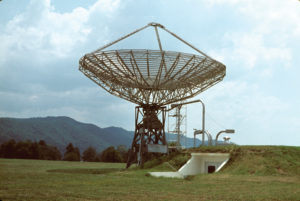
We descended into a small underground bunker, its austere metal ceilings and walls festooned with data charts, notes, and cartoon drawings from previous visiting scientists. (The telescope pictures included here and above are borrowed from online, because the satellites are beyond a red-lighted gate that bars electronics of any kind.) Working in teams of four, students learned to aim the telescope to detect radios waves emitted by Hydrogen atoms from space, at a frequency of 1420.41 MHz.
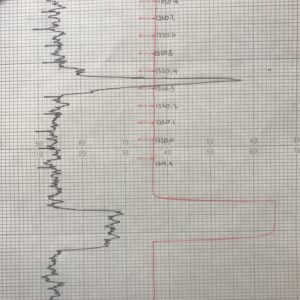
Every team member had a job: marking time & position using a metronome, adjusting the dish’s angle by fractions of degrees, analyzing the chart recorder’s scribble-graph (left), and monitoring the overall process. Each reading was truly a team effort.
By taking small samples of various patches of the hemisphere, at different times of day and night throughout the trip, students collaboratively assembled a “data puzzle” that will depict the Galactic Equator and the Galactic North Pole and South Pole. Next week in class, both sections of 7th graders will combine their data to map and analyze the big picture.
Engineering Challenges
When they weren’t busy collecting data on the ethereal galaxy, students also formed small teams to design and build products to meet challenging material specs and performance goals.
- Rocket building: Teams collaborated to plan and construct mini rockets, built around plastic film canister “engines.” Using construction paper, card stock, tape, and markers, teams competed to see who could take first place in three categories: Highest Flight, Safest Flight, and Best Looking (Flyest?) Rocket.
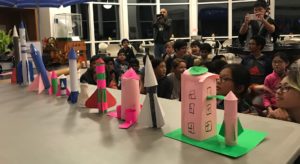 They hypothesized about size, shape, and weight, as well as how best to return their payloads safely to Earth. Once construction was complete, Mr. Young added water and Alka-Seltzer to each rocket’s film canister for an explosive gas-powered lift-off. Even though some rockets experienced difficulty on the launchpad, we had some spectacular performances. In the end, students reflected that “lighter materials and simpler designs” were the way to go.
 - GBT Engineering Design: Teams were tasked with creating a structure at least 10 inches high that would support one Dixie cup’s volume of sand for more than three seconds.
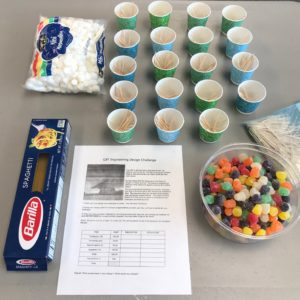 In order to obtain their building materials, they completed sketches and purchase orders, carefully deliberating on how to spend their limited funds on gum drops, toothpicks, marshmallows, raw spaghetti, and other goods. The winning team (“The Pandaz”) utilized extra supports in their tower, which gracefully supported over four times the qualifying weight. Along with their classmates, The Pandaz reflected on why certain materials and engineering decisions spelled success: “We put in crosses with the spaghetti so it wouldn’t spin or twist, and we used gum drops to make sure we had good connections. We tested to see if it could hold weight by putting a deck of cards on top.
 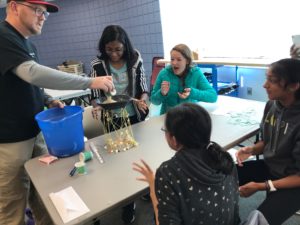 What would we do differently? Well, we originally planned to use exactly ten spaghetti pieces in the top part, but as we were building, we found we needed to add more strength to the base.”
Astronomy and Stargazing
Students learned a ton about the night sky, from visible constellations to lunar light pollution. With portable telescopes and guidance from Mr. Young and Ms. Brady, students studied the moon, Jupiter, and other celestial beauties. 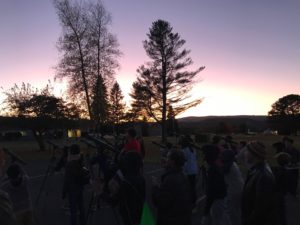 On our second and final evening, we all set off down the road on foot to see the GBT, and along the way spent a few minutes at each planet marker on the scale model of our solar system. [It’s kind of like the one at the Smithsonian, but much larger.] Students shared what they had researched for class, and taught each other about each of the planets… and also Pluto. The journey back to the dorm featured the annual “Space Race,” in which students raced up the slightly graded 1.6 mile return trip, in divisions including Speed Walking, Backwards Walking, Distance Running, and the newest category, Naruto.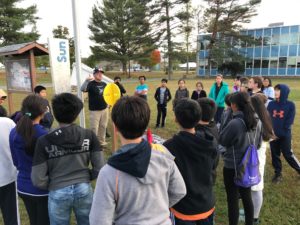
Final Thoughts
I can honestly say I have never experienced anything quite like our three-day trip to Green Bank. The staff and guides were incredibly accommodating and informative, the views were breathtaking, and the technology was absolutely astounding. It was humbling to behold machines that generations of scientists have not only envisioned, engineered, and built, but also constantly improved upon here on Earth, all to explore the vast expanses beyond our reach. The MSCS teaching team planned so many great experiences into this trip that it’s impossible to capture them all in narrative form, but I can bullet-list a few:
- Analyzing the scientific soundness of the film Contact
- Participating in science demonstrations, including one with liquid nitrogen (used to cool some of the GBT’s sensitive machinery & sensors)
- Late night and early morning trips back to the 40-foot telescope bunker, riding in a diesel truck that has no spark plugs to interfere with radio waves
- Playing frisbee on the lawn during free time
- Sending whispered messages across a 15-yard distance using parabolic reflectors
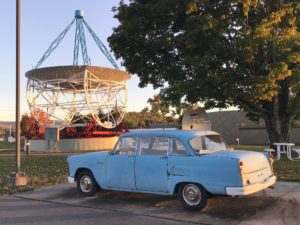 AND one final, lasting impression that the trip has left on me—and I think on all of us, to at least some extent—is a reminder that there IS life without cell phones and our ubiquitous technological interconnectivity. Even returning to 400 emails was worth it to escape my deep habit of Pavlovian response to every ping and vibration in my pocket or on my wrist. On our ride home, as we crossed back into cell range, the bus suddenly came alive with beeps, tweets, and ringtones of stalled communications—a sad and ominous audial bookend to the vocal excitement that so galvanized us when we first saw the GBT on arrival. One student a few rows back from me exclaimed, “Ohhh, man… I wish I was still in the dead zone!” I pondered this for a moment, understanding her perfectly, and then twisted back into the aisle to reply: “Well, maybe—just maybe—we can take a piece of the dead zone home with us.”
Mr. Orders, thank you so much for sharing with us and commend your writing abilities! I felt like I was transported on that trip with you guys. (U should consider writing books).
Great read and look forward to more!